
Testing Services
How we support your testing needs
- Control indoor air quality: by eliminating infiltration points
- Prevent moisture intrusion: to avoid mold, corrosion, and structural damage
- Maintain structural integrity: for long-term building performance
- Applicable to new construction and existing building conditions
Services
Roof System Testing
Roofing and waterproofing systems represent some of the highest-risk areas for owners, architects, and contractors making proper design, installation, and maintenance critical to project success. Foresight provides advanced roof testing services to identify vulnerabilities, verify performance, and prevent costly failures.
Our Focus Areas:
Our experienced technicians utilize advanced testing methods to:
- Detect concealed moisture within roof and wall assemblies
- Identify sources of water intrusion that contribute to leaks and material deterioration
- Locate areas of unintended heat loss impacting energy efficiency
- Evaluate structural and assembly deficiencies, often resulting from construction or installation errors
Each engagement is supported by clear, comprehensive reporting that documents findings, outlines contributing factors, and provides actionable recommendations to address deficiencies and prevent recurrence.
Testing Methods:
- Water Testing for Leak Source Detection using calibrated spray‑rig systems
- Humidity, Temperature, and Moisture Testing with specialized diagnostic equipment
- Infrared Thermography Scans utilizing high‑resolution thermal imaging
- Flood Testing to evaluate waterproofing system performance
- Uplift and performance
These testing services allow Foresight to accurately diagnose concealed conditions, validate system performance, and develop data‑driven recommendations for effective repairs and long‑term solutions.
Parking Facilities Testing
Not all pavement issues are visible at the surface. At Foresight, we go beyond visual inspections to identify hidden conditions within your parking facility helping ensure long‑term performance, safety, and asset value.
Importance of Testing:
To help your pavement reach its maximum possible service life and reduce long‑term costs geotechnical and pavement testing is performed to identify subsurface and material‑related issues. Our testing services provide a clear understanding of what is happening beneath the surface, why problems are occurring, and how they can be effectively corrected.
Testing allows owners and managers to:
- Identify root causes of premature pavement failure
- Validate design assumptions and construction quality
- Reduce unnecessary repairs and extend pavement life
- Make informed, cost‑effective maintenance and rehabilitation decisions
Foresight’s testing services deliver the data-driven insight needed to protect your investment and plan with confidence.
Types of Testing:
- Core Sampling: Extraction and analysis of pavement cores to evaluate asphalt thickness, material composition, layer bonding, and overall pavement integrity.
- Geotechnical Sampling: Subsurface sampling and testing to assess soil conditions, subgrade stability, moisture content, and support capacity providing critical data for design, repair, and rehabilitation decisions.
Isolated Issue Investigation: Focused testing and analysis to identify the root cause of localized pavement failures such as cracking, rutting, settlement, or drainage concerns, and to develop targeted corrective solutions.
Foresight’s testing services deliver the data-driven insight needed to protect your investment and plan with confidence.
Building Envelope Testing
Theory:
The building envelope must effectively manage water at all joints, directing it to drain properly without contributing to excessive air leakage. Failures often stem from poorly designed or improperly installed systems. To ensure both the initial product and final construction meet the owner’s expectations, building codes, and industry standards, proven testing methods are essential.
Field testing should be conducted as early as practical, ideally immediately after installation, to avoid costly and complex repairs down the line.
What We Offer:
- Controlled investigations simulating weather conditions to identify potential system failures
- Performance assurance that specified materials function as designed under maximum loads and environmental stresses
- Verification of installation sequence, ensuring proper order and accuracy for construction schedules
- Insight for designers and installers, highlighting potential issues and failure causes from traditional installation techniques
Foresight’s testing services provide confidence that your building envelope will perform as intended protecting your investment and reducing risk.
Fenestration Testing
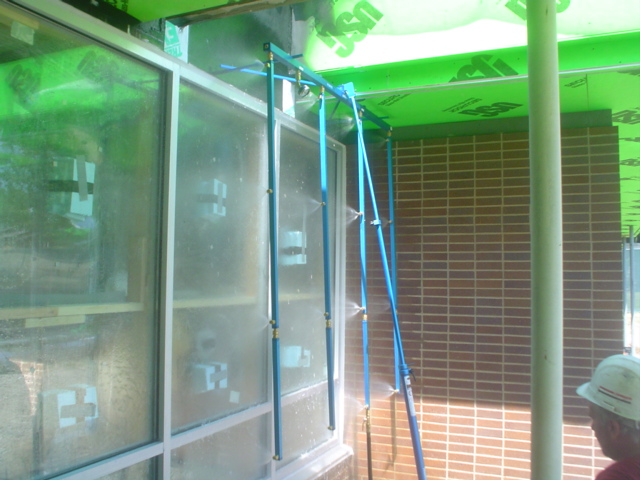
Fenestration refers to the design and placement of openings in a building’s envelope. Specialized testing simulates wind-driven rain to evaluate the performance and resilience of these openings under real-world conditions.
Concept:
Fenestration systems, such as windows, doors, and curtain walls, must be weather-tight and properly integrated with adjacent building components to maintain the integrity of the building envelope. These openings are often the most vulnerable points in a water-resistive barrier and are frequently the subject of forensic investigations due to their potential for failure.
To ensure performance and durability, fenestration testing should be conducted during the mock-up phase and throughout construction. This testing simulates real-world conditions, such as wind-driven rain, to verify that the system can resist water infiltration and maintain structural integrity under environmental stresses.
Water & Air Intrusion Testing
Testing can serve two essential purposes:
- Diagnosis: Identifying and pinpointing sources of water or air intrusion within the building envelope.
- Verification: Confirming the effectiveness of repairs and remediation efforts to ensure long-term performance.
What We Do:
Our testing methods evaluate the integrity of installed façade substrates and their connections. Failures in these systems can manifest as:
- Leaks: Allowing water penetration into the building envelope.
- Condensation Issues: Leading to moisture accumulation and potential mold growth.
- Construction Defects: Compromising long-term performance and occupant comfort.
By simulating real-world conditions, these tests help ensure that the building envelope performs as intended, maintaining durability, energy efficiency, and indoor comfort.
Forms Of Testing:
- EIFS Pull Test: Evaluates the adhesion strength of Exterior Insulation and Finish Systems (EIFS) to ensure proper bonding and durability.
- AMA Water Spray Testing: (501.2 and 502) for fenestration products
- ASTM Testing: (E283, E330, E331, E547, E779, E783, E1105, E1186, E2128, E2112, D4541, and C1153)
- Water Leakage of Masonry Wall Drainage Systems: Assesses the performance of drainage systems within masonry walls to prevent water accumulation and infiltration.
- Humidity Data Monitoring: Tracks moisture levels over time to identify potential condensation issues and verify environmental control measures.
Water Penetration of Masonry Wall Surfaces: Tests the resistance of masonry surfaces to water intrusion under simulated weather conditions.
Air Barrier Testing
Importance Of Air Barrier Control:
Air barriers play a critical role in controlling air leakage into and out of the building envelope. Beyond improving energy efficiency and occupant comfort, these systems are typically concealed beneath long-term façade materials, making access difficult and costly once installed.
This makes early testing and verification essential to ensure the air barrier meets design criteria for continuity and performance before it becomes inaccessible. Proper testing helps prevent future failures, reduces remediation costs, and ensures compliance with building codes and energy standards.
Our Capabilities:
Trained ABAA Auditor
Certified expertise in evaluating air barrier systems for compliance with ABAA standards and best practices.- Whole Building Air Leakage TestMeasures how much air leaks through cracks, gaps, seams, and penetrations in the building envelope.
Visual Inspections Verify:
- Continuity of air and water barriers
- Dry film thickness
- Wet film thickness
- Continuous support
- Correct temperature and dryness of substrates
- Maximum UV exposure limits maintained
- Surfaces properly primed
- Proper laps and overlaps
- Proper transition strips installed
- No fishmouths at seams
- Termination mastic applied where required
- Materials properly adhered
- Compatible materials used throughout
- Transitions at changes in direction and structural support
- Connections between other systems verified
- Penetrations properly sealed